Tuesday, September 15, 2009
More handwashing reminders!
...to myself! Also, in my classroom we are lucky enough to have a sink in our room so we are able to send students to wash up after putting their hands in their mouth or a big sneeze. We generally reserve hand sanitizer for the grownups, but have a child-friendly version which we sometimes use. This article is a good reminder anything is better than nothing! Stay healthy, friends.

Sunday, September 13, 2009
Can happiness become contagious...and what about preschoolers?
Can happines spread through social groups? This NYTimes article examines a study which suggests just that--happiness indeed does spread from friend to friend, even through friends of friends. Check it out!
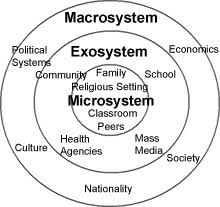 This article got me thinking about one of the most powerful and fascinating child development theories-- Urie Bronfenbrenner's Ecological Systems Theory. Looking at the picture to the right, you can see that children are in three main "environment systems". Naturally, their immediate setting influences them the most directly on a day-to-day basis: their school, family, church. But other factors play a huge role--what is the overall community attitude toward their family, school, or education? What are the health opportunities, tv shows? Impacting this level is the macrosystem--the economic system, government, culture.
There is another layer, called the mesosystem in this theory, existing between the macrosystem and the microsystem. The NYTimes article's idea that habits can be transmitted by other people in our lives or social system is supported by Bronfenbrenner's mesosystem. It is the way in which immediate players in a child's life--parents, siblings, teachers, neighbors, babysitters--interact with one another. Are there connections between home and school, for instance?
A great reminder that I need to make sure to finish all of my students' home visits to ensure that we are building a strong, communicative mesosystem!
 This article got me thinking about one of the most powerful and fascinating child development theories-- Urie Bronfenbrenner's Ecological Systems Theory. Looking at the picture to the right, you can see that children are in three main "environment systems". Naturally, their immediate setting influences them the most directly on a day-to-day basis: their school, family, church. But other factors play a huge role--what is the overall community attitude toward their family, school, or education? What are the health opportunities, tv shows? Impacting this level is the macrosystem--the economic system, government, culture.
There is another layer, called the mesosystem in this theory, existing between the macrosystem and the microsystem. The NYTimes article's idea that habits can be transmitted by other people in our lives or social system is supported by Bronfenbrenner's mesosystem. It is the way in which immediate players in a child's life--parents, siblings, teachers, neighbors, babysitters--interact with one another. Are there connections between home and school, for instance?
A great reminder that I need to make sure to finish all of my students' home visits to ensure that we are building a strong, communicative mesosystem!
Sunday, September 6, 2009
6-Year-Old Stares Down Bottomless Abyss Of Formal Schooling

This article is hilarious, except that for many children, this is true. While PreK is under forces to become increasingly like K-12 schooling, perhaps K-12 schooling should focus more on mimicking PreK. PreK, in my classroom and other high-quality settings, focuses on developing a love of learning, creativity, inquiry and critical thinking. The other reason the Onion's article is so dead-on is this is how many 6 year olds feel--what is important is playing, what is important is riding a bike. When we put ourselves in our children's shoes, we will also be better teachers.
Open Ended vs Packaged Toys

This NY Times article focused on global business - Lego's new turnout of both philosophy and profits--has some interesting implications for those concerned about the quality of play. Read the excerpt below:
But experts like Dr. Jonathan Sinowitz, a New York psychologist who also runs a psychological services company, Diagnostics, wonders at what price these sales come.“What Lego loses is what makes it so special,” he says. “When you have a less structured, less themed set, kids have the ability to start from scratch. When you have kids playing out Indiana Jones, they’re playing out Hollywood’s imagination, not their own.” Even toy analysts who admire the company and its recent success acknowledge a broad shift. “I would like to see more open-ended play like when we were kids,” says Gerrick Johnson, a toy analyst at BMO Capital Markets in New York. “The vast majority is theme-based, and when you go into Toys “R” Us, you’d really be challenged to find a simple box of bricks.”
When we think about how kids learn through play, we also need to think about what they have to play with. For instance, a toy that makes noise may appear "broken" when batteries run out, while wooden blocks have endless opportunities for children's imagination and need. Legos, too, can be a simple building block, although it looks as though the new pre-packaged sales are forcing change.
Where the Wild Things Are.....

 Get excited. Check out this profile about Spike Jonze and his long journey to bring "Where the Wild Things Are" to the screen. The best part of the article points to Mauric Sendak, the author, and Spike Jonze's affinity for the same screen vision. Ultimately, the movie is attempting to be about what being a nine year old (or may I suggest, even a 4 year old?) feels like. x Max in the book is a wild thing with wild emotions and imagination, so glad this is being done so well!
Last year, while working on a firefighters unit, my students also explored monsters. They kept refering to the fire alarm as a 'thing' that might 'get angry and yell,' so we used this as a starting place to talk about scary things --lightning, thunder, anger, darkness, shots, snakes-- all "monsters" to children and adults alike. We then talked about how we can be powerful over the monsters we fear, by saying we aren't scared, finding an adult, imagining them away. We read many great books like "There is a Monster at the End of this Book," "There's a Nightmare in My Closet" and "Go Away Big Green Monster." Maurice Sendak's "Where the Wild Things are Are" is so wonderful precisely because the monsters aren't to be feared--Max easily conquers, controls and is general powerful over the monsters of his world.
Get excited, movie comes out October 16.
Saturday, September 5, 2009
Cover that Sneeze
When I started teaching, I was excited about making sure my students were ready for kindergarten with all the pre-academic skills needed. This is still what I'm passionate about--giving my students the opportunity and experiences to develop skills, critical thinking and creativity.
Basically, I didn't think I was the front line of public health, but in many ways we (classroom teachers) are! My coteacher and I spend a lot of time helping children describe and catergorize the food choices we make and encourage even the most reluctant student to move actively outside and inside. In our classroom next week, we will be learning all about the right way to wash our hands. This week, we taught other routines, but next week, it's all about good practice with hygeine.
Most adults incorrectly wash their hands, check out the CDC reminders here. The first tricky part we teach our kids is WATER FIRST (before soap), and we are going to be better about ensuring each students is washing their hands long enough, by singing "Row Row Row Your Boat".
Work with kids? Remember to get vaccinated, remember, don't share drinks with anyone, be careful about kids' (and adults's!) greetings with touching
Basically, I didn't think I was the front line of public health, but in many ways we (classroom teachers) are! My coteacher and I spend a lot of time helping children describe and catergorize the food choices we make and encourage even the most reluctant student to move actively outside and inside. In our classroom next week, we will be learning all about the right way to wash our hands. This week, we taught other routines, but next week, it's all about good practice with hygeine.
Most adults incorrectly wash their hands, check out the CDC reminders here. The first tricky part we teach our kids is WATER FIRST (before soap), and we are going to be better about ensuring each students is washing their hands long enough, by singing "Row Row Row Your Boat".
Work with kids? Remember to get vaccinated, remember, don't share drinks with anyone, be careful about kids' (and adults's!) greetings with touching
Subscribe to:
Posts (Atom)


