Sunday, December 13, 2009
Healthcare?
This is a very disturbing article about how poor children are prescribed antipsychotic medicine at a much higher rate than other groups.

Sunday, December 6, 2009
The latest, the greatest to read
Here's the best, most interesting round-up of the latest and greatest early childhood-related news and resources!
* The BEST article to read of the past week: read it here! My sister went to a Waldorf middle and high school and had an AMAZING educational experience. I feel inspired by this story of a Waldorf forest Kindergarten to re-examine my own educational experience for my decidedly "city kids." How is my participation in the traditional PreK system (compared to this model) a bit fascist? Or isolating from nature? Could I even be out in the cold that much (the Southern in my shivered reading this article.) :) All in all, a must-read to prompt discussion!
* The NY Times' Best Illustrated Children's Books of 2009 list- read it here.
* Shakira's interview with Newsweek about the important work her nonprofit, ALAS, is doing to promote early childhood education in Latin America.
* Bob Herbert's article about a new Harvard Education School program to train more educational leaders.
* This article has gotten a lot of well-deserved attention! Good news, spread the word: early intervention works! Read about the effective toddler intervention for autism.
* Human nature arguments often rely on observations of young children. Are we hard-wired to help? Read more here.
* The BEST article to read of the past week: read it here! My sister went to a Waldorf middle and high school and had an AMAZING educational experience. I feel inspired by this story of a Waldorf forest Kindergarten to re-examine my own educational experience for my decidedly "city kids." How is my participation in the traditional PreK system (compared to this model) a bit fascist? Or isolating from nature? Could I even be out in the cold that much (the Southern in my shivered reading this article.) :) All in all, a must-read to prompt discussion!
* The NY Times' Best Illustrated Children's Books of 2009 list- read it here.
* Shakira's interview with Newsweek about the important work her nonprofit, ALAS, is doing to promote early childhood education in Latin America.
* Bob Herbert's article about a new Harvard Education School program to train more educational leaders.
* This article has gotten a lot of well-deserved attention! Good news, spread the word: early intervention works! Read about the effective toddler intervention for autism.
* Human nature arguments often rely on observations of young children. Are we hard-wired to help? Read more here.
Monday, November 23, 2009
News roundup - so much to read!
* The dog whisperer? Or the child whisperer. Some parents are taking some of tv's "Dog Whisperer" Cesar Millian's lessons to their parenting. Read for yourself here.
* I never knew there were so many children's musicians out there until the NAEYC conference. Here is a local band rockin' it for the kids.
* White Houses pushes science and math education, including through public broadcasting, this article reports.
* How do we teach the civil rights movement to kids? It matters, even in early childhood. Is it something that a few bold people did? Or is it something that lots of people did over years? Read about Claudette Colvin, whose actions spurred the chain of events that led to the Montgomery Bus Boycott.
* I'm going to show this story to the physical therapists at my school, fairly amazing story about the possibilities. Read more here
* Early Intervention is extremely effective for infants/toddlers with autism. Read more about this encouraging study here
* One more article about how Disney is not for kids, sometimes. Read here
* I never knew there were so many children's musicians out there until the NAEYC conference. Here is a local band rockin' it for the kids.
* White Houses pushes science and math education, including through public broadcasting, this article reports.
* How do we teach the civil rights movement to kids? It matters, even in early childhood. Is it something that a few bold people did? Or is it something that lots of people did over years? Read about Claudette Colvin, whose actions spurred the chain of events that led to the Montgomery Bus Boycott.
* I'm going to show this story to the physical therapists at my school, fairly amazing story about the possibilities. Read more here
* Early Intervention is extremely effective for infants/toddlers with autism. Read more about this encouraging study here
* One more article about how Disney is not for kids, sometimes. Read here
Sunday, November 22, 2009
PreK News Roundup
* Will Kindergarten test admission "test prep" become the norm? For a sliver of Manhattan's families who want to get into gifted and talented programs, it is. Bad news for 1. the validity of testing 2. richer families always getting ahead of poorer and 3. anyone who cares about childhood Check out the article here.
* Slate.com says that "Yo Gabba Gabba" is the new cool preschooler show, featuring such artists as The Shins with "edutainment" for parents and kids alike. This article has some silly and unnecessary hating on "Sesame Street", but otherwise of interest. I hope to check it out, you can read the article here.
* Teachers are selling their work to other teachers--lesson plans, resourcs, etc. Some teachers in this article are making some serious cash, but some feel it isn't something that should be bought and sold. Read it here.
* How is research conducted by rats for humans? Read from Slate.com here.
* Slate.com says that "Yo Gabba Gabba" is the new cool preschooler show, featuring such artists as The Shins with "edutainment" for parents and kids alike. This article has some silly and unnecessary hating on "Sesame Street", but otherwise of interest. I hope to check it out, you can read the article here.
* Teachers are selling their work to other teachers--lesson plans, resourcs, etc. Some teachers in this article are making some serious cash, but some feel it isn't something that should be bought and sold. Read it here.
* How is research conducted by rats for humans? Read from Slate.com here.
Are you a welcoming school?
Check out the Human Rights Campaign (HRC)'s Welcoming School campaign here. It has great resources for schools and teachers to support all children and families, particularly the LGBTQ community. There are ideas for books for grades PreK-6 on defying gender stereotypes, anti-bullying, gay and lesbian families/parents and many more. There is a longer user pdf with more information and advice. Also, I love that Todd Parr made a special graphic just for the campaign!

You'll never look at 'silent e' the same way again!
At NAEYC, I heard from PBS about children's programming aimed at preschoolers. Currently, there are several shows that are aimed at preschoolers, with a focus on print and the meaning of words. There is a also a new "Electric Company" aimed at 6-9 year olds with possibly the coolest "silent e" song ever! Check it out here. I had a great conversation with another teacher regarding television: we don't ever want to encourage parents or families to watch more tv. However, if children are going to watch tv, we would prefer that they watch pbs shows. While other kids programming may still be better than other choices, PBS conducts actual educational research to make decisions. My advice to families, then, is mixed "If you must watch tv, watch PBS. Otherwise, turn it off!" To other teachers, for more information click here.


NAEYC !
This week, I've spent three days at the National Association for the Education of Young Children. It's been both a gift I've given myself--time to learn, time to grow, time to reflect without the demands of my classroom--and entirely overwhelming! Some of the take-aways from the conference for me were more motivational, otherws were more specific. I feel excited and energized to do more science and math that is authentic and inquiry-based. My co-teacher is gifted at sensory play and we have plants and animals, but we can (and will!) do more! Many of my following posts will be some of the ideas and resources I found at the NAEYC conference.
Saturday, November 14, 2009
I'm Too Sexy For My Onesie
This article isn't surprising to those of us experiencing the way media affects young children, but some of the details are shocking. The 'tween' focused Disney shows, the onesies --all introducing and reinforcing the idea that girls should be sexy and boys should want sex. This is a must-read article if you are teacher, a parent or a feminist. I am thinking of what many little girl's print tees have read over the years--"sexy" on a three year old, for instance, or the vamped-out 'Bratz' dolls. Don't get me started on the way Miley Cyrus is marketed to three and four year olds. I like Miley fine, but selling her tween sex symbol shirts to two-and-half-year-olds? Creepy, yes, but also detrimental. I think it's important to note the ways the authors make clear--today's 6 or 10 or 16 year-old kids aren't more interested in sex, but more sex is being marketed at them.
Rising to the challenge
Ellis Cose is one of my favorite commentators in general, but check out his recent article here. He talks about something that rarely came up in the discussion of the 40th year anniversary of Sesame Street --the idea that television could do a better job of educating children. In the end, Cose ends with a powerful argument for universal, high-quality preschool.
Packrat and PreK
Is being a packrat compatible with being a PreK teacher? I say yes--I can always use virtually EVERYTHING. Yes, I can use that empty coffee can, and the egg crate, and that old telephone book! Case in point: this week, we were encouraging students to keep acting out "Humpty Dumpty." Luckily, a friend who teaches at my school had plastic Easter eggs (where else could I have found Easter eggs in November?) and a brick for the 'wall'! My husband, who disagrees with my philosophy, sent me this article. I literally laughed out loud, as I fall into each one of these 'myths'. I'll clean up when I get organized, I get another container, I find the perfect new owner, I convince myself I still might find a use. Compulsive saver? Yes, I am. I try not to. But does it make me a better PreK teacher? Much to my husband's chagrin, I think it does!
Debunking of "educational" resources
I found this excellent series from the Early Ed Watch blog. The Washington Post features Daniel Willingham debunking the "science" around an educational product, 'eyeQ'. It's actually being tested in a school system right now, but not based on much. This is a bit of a follow-up to the Baby Einstein --if what they are promising is too good, it probably is.
Eliminating Asperger's from the DSM?
This article explores the possibility Asperger's syndrome will be eliminated from the DSM, leaving just autism. The author argues we don't enough about the causes yet to really determine if that's appropriate. Also, he mentions the families who've waited for a diagnosis who will be frustrated, which is fair. Interesting debate over catagorizing differences and/or disability.
Scary chemcials
BPA may be to blame for early onsets of puberty in girls, problems in pregnancy, among other scary possibilities, Nicholas Kristof summarizes here. Scary stuff.
Tuesday, October 27, 2009
2-5 Year olds watch 32 hours of TV
So this article is basically crying out for a post. The horrifying part is pretty self-explanatory--kids 2-5 are watching way more tv then they should. Compared to their older siblings (who watch less tv), it's clearly being used as a clear babysitter. The really hard thing for me to think about is if you were to take a sample of my room-- some students only watch, say, 5 hours of tv (say, Dora every afternoon, movie on tv on weekend). What about the kids who I know watch a LOT of tv? How much are they watching to move that average to 32 hours?
Sunday, October 25, 2009
Classroom Glimpse


So far on this blog experiment, I've blogged a lot about the news and policy I read, but haven't really talked about my classroom. I'm lucky to have a ton of materials, albeit in a small space! Here are a few glimpses of my classroom space: my hermit crab tank (with an Eric Carle book nearby to support learning). While having a hermit crab and fish are a lot of daily and weekly upkeep, I think it's important to have living creatures in a classroom for my students to get hands-on science experiment. The next picture is of our weekly poem or song to support our theme and literacy objects. We read them (or sing this one!) with a pointer, then students can interact on their own in centers. This is one of our favorite songs. I'll try to post more glimpses into my classroom soon!
www.urbanpreschool.com
Urban Preschool is one of my favorite websites to inspire me as an early educator. I've mentioned here before, but worth checking out again often!
Consequences of not vaccinating kids
This is a really important perspective on the consequences of parents opting out of vaccinating children. It's frustrating to hear about parents refusing to follow scientific evidence and the interest of the greater public health. Here's the story of a mom whose son with cancer is at risk from these children.
Einstein Baby Scam
Finally, admitting what a scam Baby Einstein is! I have often had to grit my teeth when families I know socially or through my students tell me how they use Baby Einstein. It makes me crazy, crazy, crazy.
The best way to make your baby's brain grow? Talk to them all the time. Limit tv and other electronics to a bare minimum. At the same time, Baby Einstein is better than other tv or videos for very young children. However, promoting absolutely anything on the tv for such young children is negligent.
The best way to make your baby's brain grow? Talk to them all the time. Limit tv and other electronics to a bare minimum. At the same time, Baby Einstein is better than other tv or videos for very young children. However, promoting absolutely anything on the tv for such young children is negligent.
Becoming a teacher
I love this article, because I love hearing about people becoming teachers, and I think people who've been successful elsewhere would be great. Half of my learning curve my first two years teaching was learning to work as an adult, something no amount of internships or part-time jobs taught me.
We teachers are lucky in that no matter what else about our job--the hours, the stress, the random shin splints from running like crazy around the pumpkin patch--we have meaning in what we do. The essence of what these people are searching for is meaning in their work. Why work without it? At the end of the day, I know my work matters.
We teachers are lucky in that no matter what else about our job--the hours, the stress, the random shin splints from running like crazy around the pumpkin patch--we have meaning in what we do. The essence of what these people are searching for is meaning in their work. Why work without it? At the end of the day, I know my work matters.
Shouting the new spanking?
How to be a good parent? And where are the lines? I think that's what this article is ultimately addressing. For the teachers out there: how to be a good teacher? And where is the line? What if you lose your temper? How to prevent in the future?
Friday, October 9, 2009
The Very Wonderful Caterpillar
I LOVE SLATE. I love, love, love Slate. That said, this is the most ridiculous article EVER.
1. I love The Very Hungry Caterpillar. It is one of the few books I will read over, and over, and over again in my classroom without becoming crazy.
2. His wife (an elementary literacy specialist) is right and I would add to it. The simplicity of a story for especially preschoolers both draws them in and engages them at a level they can master. What a powerful book! My returning four year olds will engage in complicated play-counting up the total number of fruit the caterpillar eats and use sentence starter/structures of "On ____, he at through ____ ______" to use clues to identify words. My three year olds will be able to conceptualize beginning, middle, end and numeral concepts (see, three strawberries! 1, 2, 3). My DLL (dual language learner) students after multiple repeats in two languages have read a book that maintains its charm in re-telling. A few of the things we talk about in my class about this book: the passage of time, the lifecycle of a butterfly, types of fruit, how the last number we count represents the whole (1, 2, there are 2), junk food vs healthy food and sequence.
3. It's really interesting that the author of the article things children focus on the pictures. Hence the harm in assuming one's own experience reading to one toddler represent all experiences with all children.
1. I love The Very Hungry Caterpillar. It is one of the few books I will read over, and over, and over again in my classroom without becoming crazy.
2. His wife (an elementary literacy specialist) is right and I would add to it. The simplicity of a story for especially preschoolers both draws them in and engages them at a level they can master. What a powerful book! My returning four year olds will engage in complicated play-counting up the total number of fruit the caterpillar eats and use sentence starter/structures of "On ____, he at through ____ ______" to use clues to identify words. My three year olds will be able to conceptualize beginning, middle, end and numeral concepts (see, three strawberries! 1, 2, 3). My DLL (dual language learner) students after multiple repeats in two languages have read a book that maintains its charm in re-telling. A few of the things we talk about in my class about this book: the passage of time, the lifecycle of a butterfly, types of fruit, how the last number we count represents the whole (1, 2, there are 2), junk food vs healthy food and sequence.
3. It's really interesting that the author of the article things children focus on the pictures. Hence the harm in assuming one's own experience reading to one toddler represent all experiences with all children.
Sunday, October 4, 2009
Must-read articles
The best and most interesting PreK-relevant material I've been reading:
* Early Ed Watch Blog on Head Start and school readiness (part of a series)
* Advice for parents on finding a play-based preschool
* From Slate, advice on working on changing kids behaviors
* Great list for any parents or early educators: anti-bias curriculum books for PreK and Kindergarten students. Teaching for Change is an amazing organization that works to support educators and be explicit about race, gender, sexuality, etc, so as to break down stereotypes.
* Haven't checked out this movie clip yet, but interesting premise: "Two Angry Moms" take on school lunches
* Really important but disturbing article. I as an educator often don't think of my students as being capable of depression, but read this to be more aware.
* I do like the message (but not the tone) of the article: talk to your kids, all the time, all the time, all the time. They learn vocabulary, context and nuance.
* Early Ed Watch Blog on Head Start and school readiness (part of a series)
* Advice for parents on finding a play-based preschool
* From Slate, advice on working on changing kids behaviors
* Great list for any parents or early educators: anti-bias curriculum books for PreK and Kindergarten students. Teaching for Change is an amazing organization that works to support educators and be explicit about race, gender, sexuality, etc, so as to break down stereotypes.
* Haven't checked out this movie clip yet, but interesting premise: "Two Angry Moms" take on school lunches
* Really important but disturbing article. I as an educator often don't think of my students as being capable of depression, but read this to be more aware.
* I do like the message (but not the tone) of the article: talk to your kids, all the time, all the time, all the time. They learn vocabulary, context and nuance.
Tuesday, September 15, 2009
More handwashing reminders!
...to myself! Also, in my classroom we are lucky enough to have a sink in our room so we are able to send students to wash up after putting their hands in their mouth or a big sneeze. We generally reserve hand sanitizer for the grownups, but have a child-friendly version which we sometimes use. This article is a good reminder anything is better than nothing! Stay healthy, friends.
Sunday, September 13, 2009
Can happiness become contagious...and what about preschoolers?
Can happines spread through social groups? This NYTimes article examines a study which suggests just that--happiness indeed does spread from friend to friend, even through friends of friends. Check it out!
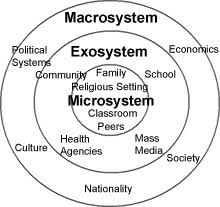 This article got me thinking about one of the most powerful and fascinating child development theories-- Urie Bronfenbrenner's Ecological Systems Theory. Looking at the picture to the right, you can see that children are in three main "environment systems". Naturally, their immediate setting influences them the most directly on a day-to-day basis: their school, family, church. But other factors play a huge role--what is the overall community attitude toward their family, school, or education? What are the health opportunities, tv shows? Impacting this level is the macrosystem--the economic system, government, culture.
There is another layer, called the mesosystem in this theory, existing between the macrosystem and the microsystem. The NYTimes article's idea that habits can be transmitted by other people in our lives or social system is supported by Bronfenbrenner's mesosystem. It is the way in which immediate players in a child's life--parents, siblings, teachers, neighbors, babysitters--interact with one another. Are there connections between home and school, for instance?
A great reminder that I need to make sure to finish all of my students' home visits to ensure that we are building a strong, communicative mesosystem!
 This article got me thinking about one of the most powerful and fascinating child development theories-- Urie Bronfenbrenner's Ecological Systems Theory. Looking at the picture to the right, you can see that children are in three main "environment systems". Naturally, their immediate setting influences them the most directly on a day-to-day basis: their school, family, church. But other factors play a huge role--what is the overall community attitude toward their family, school, or education? What are the health opportunities, tv shows? Impacting this level is the macrosystem--the economic system, government, culture.
There is another layer, called the mesosystem in this theory, existing between the macrosystem and the microsystem. The NYTimes article's idea that habits can be transmitted by other people in our lives or social system is supported by Bronfenbrenner's mesosystem. It is the way in which immediate players in a child's life--parents, siblings, teachers, neighbors, babysitters--interact with one another. Are there connections between home and school, for instance?
A great reminder that I need to make sure to finish all of my students' home visits to ensure that we are building a strong, communicative mesosystem!
Sunday, September 6, 2009
6-Year-Old Stares Down Bottomless Abyss Of Formal Schooling

This article is hilarious, except that for many children, this is true. While PreK is under forces to become increasingly like K-12 schooling, perhaps K-12 schooling should focus more on mimicking PreK. PreK, in my classroom and other high-quality settings, focuses on developing a love of learning, creativity, inquiry and critical thinking. The other reason the Onion's article is so dead-on is this is how many 6 year olds feel--what is important is playing, what is important is riding a bike. When we put ourselves in our children's shoes, we will also be better teachers.
Open Ended vs Packaged Toys

This NY Times article focused on global business - Lego's new turnout of both philosophy and profits--has some interesting implications for those concerned about the quality of play. Read the excerpt below:
But experts like Dr. Jonathan Sinowitz, a New York psychologist who also runs a psychological services company, Diagnostics, wonders at what price these sales come.“What Lego loses is what makes it so special,” he says. “When you have a less structured, less themed set, kids have the ability to start from scratch. When you have kids playing out Indiana Jones, they’re playing out Hollywood’s imagination, not their own.” Even toy analysts who admire the company and its recent success acknowledge a broad shift. “I would like to see more open-ended play like when we were kids,” says Gerrick Johnson, a toy analyst at BMO Capital Markets in New York. “The vast majority is theme-based, and when you go into Toys “R” Us, you’d really be challenged to find a simple box of bricks.”
When we think about how kids learn through play, we also need to think about what they have to play with. For instance, a toy that makes noise may appear "broken" when batteries run out, while wooden blocks have endless opportunities for children's imagination and need. Legos, too, can be a simple building block, although it looks as though the new pre-packaged sales are forcing change.
Where the Wild Things Are.....

 Get excited. Check out this profile about Spike Jonze and his long journey to bring "Where the Wild Things Are" to the screen. The best part of the article points to Mauric Sendak, the author, and Spike Jonze's affinity for the same screen vision. Ultimately, the movie is attempting to be about what being a nine year old (or may I suggest, even a 4 year old?) feels like. x Max in the book is a wild thing with wild emotions and imagination, so glad this is being done so well!
Last year, while working on a firefighters unit, my students also explored monsters. They kept refering to the fire alarm as a 'thing' that might 'get angry and yell,' so we used this as a starting place to talk about scary things --lightning, thunder, anger, darkness, shots, snakes-- all "monsters" to children and adults alike. We then talked about how we can be powerful over the monsters we fear, by saying we aren't scared, finding an adult, imagining them away. We read many great books like "There is a Monster at the End of this Book," "There's a Nightmare in My Closet" and "Go Away Big Green Monster." Maurice Sendak's "Where the Wild Things are Are" is so wonderful precisely because the monsters aren't to be feared--Max easily conquers, controls and is general powerful over the monsters of his world.
Get excited, movie comes out October 16.
Saturday, September 5, 2009
Cover that Sneeze
When I started teaching, I was excited about making sure my students were ready for kindergarten with all the pre-academic skills needed. This is still what I'm passionate about--giving my students the opportunity and experiences to develop skills, critical thinking and creativity.
Basically, I didn't think I was the front line of public health, but in many ways we (classroom teachers) are! My coteacher and I spend a lot of time helping children describe and catergorize the food choices we make and encourage even the most reluctant student to move actively outside and inside. In our classroom next week, we will be learning all about the right way to wash our hands. This week, we taught other routines, but next week, it's all about good practice with hygeine.
Most adults incorrectly wash their hands, check out the CDC reminders here. The first tricky part we teach our kids is WATER FIRST (before soap), and we are going to be better about ensuring each students is washing their hands long enough, by singing "Row Row Row Your Boat".
Work with kids? Remember to get vaccinated, remember, don't share drinks with anyone, be careful about kids' (and adults's!) greetings with touching
Basically, I didn't think I was the front line of public health, but in many ways we (classroom teachers) are! My coteacher and I spend a lot of time helping children describe and catergorize the food choices we make and encourage even the most reluctant student to move actively outside and inside. In our classroom next week, we will be learning all about the right way to wash our hands. This week, we taught other routines, but next week, it's all about good practice with hygeine.
Most adults incorrectly wash their hands, check out the CDC reminders here. The first tricky part we teach our kids is WATER FIRST (before soap), and we are going to be better about ensuring each students is washing their hands long enough, by singing "Row Row Row Your Boat".
Work with kids? Remember to get vaccinated, remember, don't share drinks with anyone, be careful about kids' (and adults's!) greetings with touching
Monday, August 31, 2009
The Allergy Craze/Debate
I had a child in my room last year with a severe peanut allergy, so I know how severe and real this can be for educators and parents! To make matters worse, he also experienced allergies to other common foods and irritants found outside. The dangerous part for this child was that he also had asthma, so any inflammation was dangerous for him.
However, that said, as this article points out, food allergies are far less dangerous than many other issues facing children and their families. Food allergies are real, but the research certainly has some disturbing holes in it.
However, that said, as this article points out, food allergies are far less dangerous than many other issues facing children and their families. Food allergies are real, but the research certainly has some disturbing holes in it.
Sunday, August 30, 2009
Hold the Mac-n-Cheese, please
I love Mother Jones, and encourage you to check out their online reporting. They truly address the reporting that doesn't appear anywhere else. Processed mac-n-cheese: could anything represent an American childhood more? I remember making my very own vat for dinner, and know this is one of the staples many of my students eat. Read more about why we should be wary (or insist on different regulation, at the Europeans have) here:
http://www.motherjones.com/blue-marble/2009/08/mac-n-cheese-safer-please
http://www.motherjones.com/blue-marble/2009/08/mac-n-cheese-safer-please
The power of choice
As an early educator, I think of ways to empower my students to make daily choices. I know both the anecdotal evidence: children are engaged far longer than I often believe them capable of when they CHOOSE their "choice time" or center time activity. We also know that it's important for preschoolers to engage in choice so they develop a sense of their own initiative according to Erikson's levels of development (preschoolers = initiative vs. guilt).
This article points to the power of choice at other levels of education: can/should/how can middle schoolers pick their own books to read? Read more here: http://www.nytimes.com/2009/08/30/books/30reading.html?emc=eta1
This article points to the power of choice at other levels of education: can/should/how can middle schoolers pick their own books to read? Read more here: http://www.nytimes.com/2009/08/30/books/30reading.html?emc=eta1
Beginning of School Nerves
My students come tomorrow, and I wish I could say I was thrilled and excited. I am, of course, excited for my new 2, 3 and 4 year olds to come start a new year. I've spent time preparing for them, I've even dreamed about them. But I also get nerves, just like when I was a student starting out! I know my students' year is high stakes--for me, for my life, but mostly for theirs. It matters what they learn, how they interact with their peers, what connections they make. It matters what words they know, what experiences help make them curious about the world. Here we go! :)
But you don't have to take my word for it.....
My husband and I both credit our love of reading to many things: parents who read nightly to us, great teachers and schools and just a little bit innate nature of both being Gemini-reading-and-talking-about-everything people. As children of the 80s, we both literally grew up with Reading Rainbow. It was very influential in how I imagined how books could come to life. My husband loves the episode where they go to the diner to explore the themes of the "The Robbery of the Diamond Dog Diner." One of my favorites involved going to a hat shop.
This article talks about some of the pressures, including the Bush administration's (lack of?) priorities which contributed to the ending of the show. The conflict seems to be between the goal of teaching kids to read --which Reading Rainbow didn't do. As quoted, it teaches kids "why to read." From our now adult perspective, the show built schema and background knowledge which helped young readers explore the possibilities of reading.
Check out the below referenced article, if only for the awesome title song clip!
http://thinkprogress.org/2009/08/28/reading-rainbow/
This article talks about some of the pressures, including the Bush administration's (lack of?) priorities which contributed to the ending of the show. The conflict seems to be between the goal of teaching kids to read --which Reading Rainbow didn't do. As quoted, it teaches kids "why to read." From our now adult perspective, the show built schema and background knowledge which helped young readers explore the possibilities of reading.
Check out the below referenced article, if only for the awesome title song clip!
http://thinkprogress.org/2009/08/28/reading-rainbow/
Thursday, August 20, 2009
Co-Teaching as Marriage Analogy
 Two teachers in a classroom are, to me, in an arranged marriage! I am so grateful and lucky to have a talented co-teacher, but it is difficult to well with someone over so much time! I just did a workshop for first year teachers about working with co-teachers. I used this collaboration model from the Thomas Kilmann Conflict Mode Instrument to talk about how we want to build a relationship with our co-teacher, but we also want to work towards our goals. It was a tool presented to me as a pre-marital strategy, but it works for teachers to think about their level of compromise and/or collaboration with their teaching team
Citation: http://en.wikipedia.org/wiki/Thomas_Kilmann_Conflict_Mode_Instrument
Lisa Guernsey at The Early Ed Watch Blog on Chuck Norris on Obama legislation (Check it out here: http://www.newamerica.net/blog/early-ed-watch/2009/bring-pain-chuck-norris-home-visitation-plan-13865). This is an especially great blog, enjoy when they have a sense of humor about public discourse and media coverage of early childhood.
Tuesday, August 18, 2009
Barriers to Accessing High Quality PreK
Check it out at: http://www.racewire.org/archives/2009/08/an_early_start_for_children_of_1.html
I love the picture of these students in the article---happily reading one of my students' favorite stories, "Go Away Big Green Monster"! This article is interesting, since it reveals the layers that prevent all families from equally accessing opportunities for PreK. While not very heartening, it reminds us that even in a city like Chicago, which is considered a leader in early childhood opportunities, we gotta close the access gap!
I love the picture of these students in the article---happily reading one of my students' favorite stories, "Go Away Big Green Monster"! This article is interesting, since it reveals the layers that prevent all families from equally accessing opportunities for PreK. While not very heartening, it reminds us that even in a city like Chicago, which is considered a leader in early childhood opportunities, we gotta close the access gap!
Home Visits Are Essential! Do Them!
Check out this article: /05/tln_ferlazzo.html?tkn=OOXDetwFBuBH4ZKBsE5Xbdnt42VwVp1Zd9gs
This educator amazes me, since he tries to visit so many of his large caseload of high schoolers' homes! I try to make sure to conduct home visits at the beginning of the year-- if before school starts, it puts students, parents and myself at ease. Most I conduct throughout the fall as I am able, especially after I've explained the benefit to families who are often wary. The trust that can be built between you and families at the beginning of the year sets the right basis for a wonderful year!
Elements of a good home visit:
1. Ask questions to understand the family: where are you from? Habits/routines of the home? What is important to you? Meet a family member who doesn't drop off?
2. Spend 80% of the time listening! At school conferences, teachers often do most of the talking and informing of a child's progress. This is a great opportunity to really relax and be a good listener.
3. Use your knowledge for good communication throughout the year. You now know what this family's interests are (can you come help us cook a chili in our classroom?), struggles are (how is your other daughter feeling?) and concerns are (I really think your child is interacting more with other students).
4. Share appropriate information of yourself. Teachers are people, with families, spouses and interests. Sharing these stories helps families feel you are approachable.
5. Show interest in student/child if present. Remember bumping into your teacher at the grocery store, the shock of the knowledge teachers leave school? I'm always amazed by how different students will be in their home than at school, giving greater insight into their whole being, not their school facade.
Another resources that have helped influence my home visit philosophy and views: Black Ants and Buddhists by Mary Cowhey
This educator amazes me, since he tries to visit so many of his large caseload of high schoolers' homes! I try to make sure to conduct home visits at the beginning of the year-- if before school starts, it puts students, parents and myself at ease. Most I conduct throughout the fall as I am able, especially after I've explained the benefit to families who are often wary. The trust that can be built between you and families at the beginning of the year sets the right basis for a wonderful year!
Elements of a good home visit:
1. Ask questions to understand the family: where are you from? Habits/routines of the home? What is important to you? Meet a family member who doesn't drop off?
2. Spend 80% of the time listening! At school conferences, teachers often do most of the talking and informing of a child's progress. This is a great opportunity to really relax and be a good listener.
3. Use your knowledge for good communication throughout the year. You now know what this family's interests are (can you come help us cook a chili in our classroom?), struggles are (how is your other daughter feeling?) and concerns are (I really think your child is interacting more with other students).
4. Share appropriate information of yourself. Teachers are people, with families, spouses and interests. Sharing these stories helps families feel you are approachable.
5. Show interest in student/child if present. Remember bumping into your teacher at the grocery store, the shock of the knowledge teachers leave school? I'm always amazed by how different students will be in their home than at school, giving greater insight into their whole being, not their school facade.
Another resources that have helped influence my home visit philosophy and views: Black Ants and Buddhists by Mary Cowhey
Preschoolers' Mental Health
Check out the article: http://www.nytimes.com/aponline/2009/08/03/health/AP-US-MED-Preschoolers-Depression.html?emc=eta1
This article brings up the expectation vs reality of children and their mental health. We expect young children to be resilient to family stress or even chemical predisposition, but this is often not the case. Good for early educators like myself to be aware of when working with children exhibiting signs of depression or who are under stress.
This article brings up the expectation vs reality of children and their mental health. We expect young children to be resilient to family stress or even chemical predisposition, but this is often not the case. Good for early educators like myself to be aware of when working with children exhibiting signs of depression or who are under stress.
Article: Your Baby Is Smarter Than You Think
Check out this article from the NYT: http://www.nytimes.com/2009/08/16/opinion/16gopnik.html?emc=eta1 - "Your Baby Is Smarter Than You Think" by Alison Gopnik. I love this article and hope you'll check it out for a few reasons:
1. I love pretty much anything in the mainstream media that brings the importance of early childhood to the forefront of daily and political discussions.
2. Articles like this make lots of theory accessible and fast to read, making it perfect to pass out to my busy classroom parents.
3. She has GOOD practical ideas. You don't need Baby Einstein to make your kid smart, you need to talk to your child! If your preschooler moves around all the time, that's normal!
4. We need more discussion and awareness of how early childhood discussion DOESN'T start at preschool, but at birth. I would love to work in the future with a more baby and toddler setting, I think it is so important!
1. I love pretty much anything in the mainstream media that brings the importance of early childhood to the forefront of daily and political discussions.
2. Articles like this make lots of theory accessible and fast to read, making it perfect to pass out to my busy classroom parents.
3. She has GOOD practical ideas. You don't need Baby Einstein to make your kid smart, you need to talk to your child! If your preschooler moves around all the time, that's normal!
4. We need more discussion and awareness of how early childhood discussion DOESN'T start at preschool, but at birth. I would love to work in the future with a more baby and toddler setting, I think it is so important!
An Urban East Coast Teacher's PreK Journey - Join in!
Welcome!
I'm a PreK teacher of three and four year old students at a small public school in an East Coast city. This is my fourth year teaching, and my second year at my school. I'm passionate about my classroom, my students and their success. I'm excited about all the attention that early childhood is getting locally and nationwide, but I want to ensure that preschoolers are receiving high-quality, developmentally appropriate programming.
I've started this blog to put out my experiences in the classroom, while trying to respect my school's and students' privacy. I want to share my successes, but don't want to sugar-coat the realities of the day-to-day struggles I face while teaching. I read a lot of early childhood blogs and articles, and plan on sharing my thoughts on policy. If you blog, let's link to each other's blog. If you teach or read, please comment. If you care about making early childhood a vivid part of the American politcal discourse, chime in. The blog attempt starts now, join in!
I'm a PreK teacher of three and four year old students at a small public school in an East Coast city. This is my fourth year teaching, and my second year at my school. I'm passionate about my classroom, my students and their success. I'm excited about all the attention that early childhood is getting locally and nationwide, but I want to ensure that preschoolers are receiving high-quality, developmentally appropriate programming.
I've started this blog to put out my experiences in the classroom, while trying to respect my school's and students' privacy. I want to share my successes, but don't want to sugar-coat the realities of the day-to-day struggles I face while teaching. I read a lot of early childhood blogs and articles, and plan on sharing my thoughts on policy. If you blog, let's link to each other's blog. If you teach or read, please comment. If you care about making early childhood a vivid part of the American politcal discourse, chime in. The blog attempt starts now, join in!
Subscribe to:
Posts (Atom)


